


(Ruth Holzhauser is, of course, another relative. She’s my great aunt: the wife of my grandpa’s brother, Stanley. I remember her, but can’t say I remember anything specific about her. I’m sorry, Ruth.)
In the past few months, I’ve been reading a lot of food history about chickens as we know them today. I’ve learned which species modern meat and egg chickens evolved from and how humans bred them and spread them across the world. What I was surprised to learn is that throughout history, most cultures thought chickens were pretty gross. Some historic cultures revered them as gods or seers and sacrificed them, but weren’t interested in eating them. They were even referred to as “dung hill fowl” by the American colonists because that’s where they found them scratching around most of the time. Because of the disgust and disdain the upper class felt for them, they were generally ignored as a food item, even here in the US until very, very recently. In the case that a household did have chickens, the women or the enslaved people tended to them. In fact, until World War II, chicken was considered a “feminine” food eaten only by sick people, women, and of course, the poor when there was nothing else around.
When the American Civil War started, chickens were only fed to soldiers who were sick (the history of chicken soup goes back thousands of years!), but it didn’t take too long before starving southern soldiers began raiding chicken coops to find a meal. During the same time, fried chicken was becoming popular among everyone thanks to the growth of the railroads.
Researchers say the fried chicken we know today was a mix of Scots who migrated to the southern states in the 1700s, and more importantly, enslaved Africans. Many enslaved people in the south kept and tended to chickens because the enslavers thought chickens were useless. This offered extra food in the form of meat and eggs to enslaved people who were denied everything but scraps from the enslavers. (Most of the southern food we eat today is born of enslaved Africans trying to make the most with the very little they could find.) The white enslavers found chickens so unimportant, they gave “permission” to enslaved Africans (generally women) to sell their fried chicken to travelers. Some families were able to buy their way into freedom from selling fried chicken and eggs.
After emancipation, black cooks who worked for white families refused to make fried chicken since it took such time to kill, pluck, quarter, and prepare such a meal. To choose to fry chicken for someone is an act of love. To deny someone is a beautiful and profound protest.
Since chickens need land to scratch around on, they were more common in rural areas; this made the price in urban areas 3-4 times more expensive per pound than beef. If you wanted some chicken, you had to have it shipped in from the country-and that wasn’t cheap. There were no massive slaughter and packing houses for chickens, so they’d be killed and simply put on ice. The chicken, with all of its organs still in place, began its journey on a train to the cities. As any hunter or anatomist knows, the process of decomposition starts the moment the heart stops. These chickens spent more than 24 hours just riding the rails, enduring all sorts of temperatures and delays. A lot of times they arrived to their destination pretty smelly.
Of course the rich people had their super big party planned and wanted to make sure everyone knew just how rich they were, so those chickens were going to be used. But you can’t really roast a whole, spoiled chicken. What can you do? Well, first, you cut all the meat into small pieces, smother it in mayonnaise, add some vegetables and herbs, and you can hardly taste the bum bird! Chicken salad was born. Since rich people were the ones eating it, and it still wasn’t considered manly (chicken wasn’t even considered meat yet), women made it popular in the late 1800s. Yes, rich women loved chicken salad: it was fancy and delicate and white-just like them.
Of course, rich white men started to see that women and minorities were starting to prosper with their chicken businesses and moved in to take over, especially after the Great Depression. Tyson started his business of slaughter houses and meat packing (cut-up chickens instead of dead ones with all their innards) and by WWII, soldiers were eating all the beef and demand for chickens grew exponentially. In 1948, there was a “Chicken of Tomorrow” contest held to see who could make the meatiest bird, and now we have chickens with breasts so big they can’t support their own weight, chickens who mature in weeks instead of months, and chickens packed so tightly in cages, their beaks are burned off so they don’t peck each other to death.
________________________
The only chicken I crave or enjoy eating is fried chicken but only the dark meat. Chicken breasts are always so dry and flavorless. You will never see me eating a grilled chicken breast sandwich or ordering any form of chicken at a restaurant.
Aunt Ruth’s recipe specifies using white meat. When I was first reading the recipe, I figured that’s a hold-over from those rich white women and their nasty-ass, spoiled chickens slathered in mayo to keep up appearances. I’d also learned in my research that those women preferred the white meat because it was, well, white. I decided to do a little bit of chicken salad research.
Apparently, Southern Living magazine food writer Lisa Cericola says whatever you do, don’t use dark meat in your chicken salad. Why? Because white meat is flavorless (I told you) and firmer, so it’s better hidden by all the mayo and veggies. She says to save the dark meat for chicken dinners. I guess I agree that a chicken salad is one way to make dry white meat a little more interesting.
However, I also see a chicken salad as as way to use up leftovers, especially this strange recipe of random items. So, I say use whatever you want or whatever you have. Just keep in mind: it all started with spoiled chicken.
_______________________
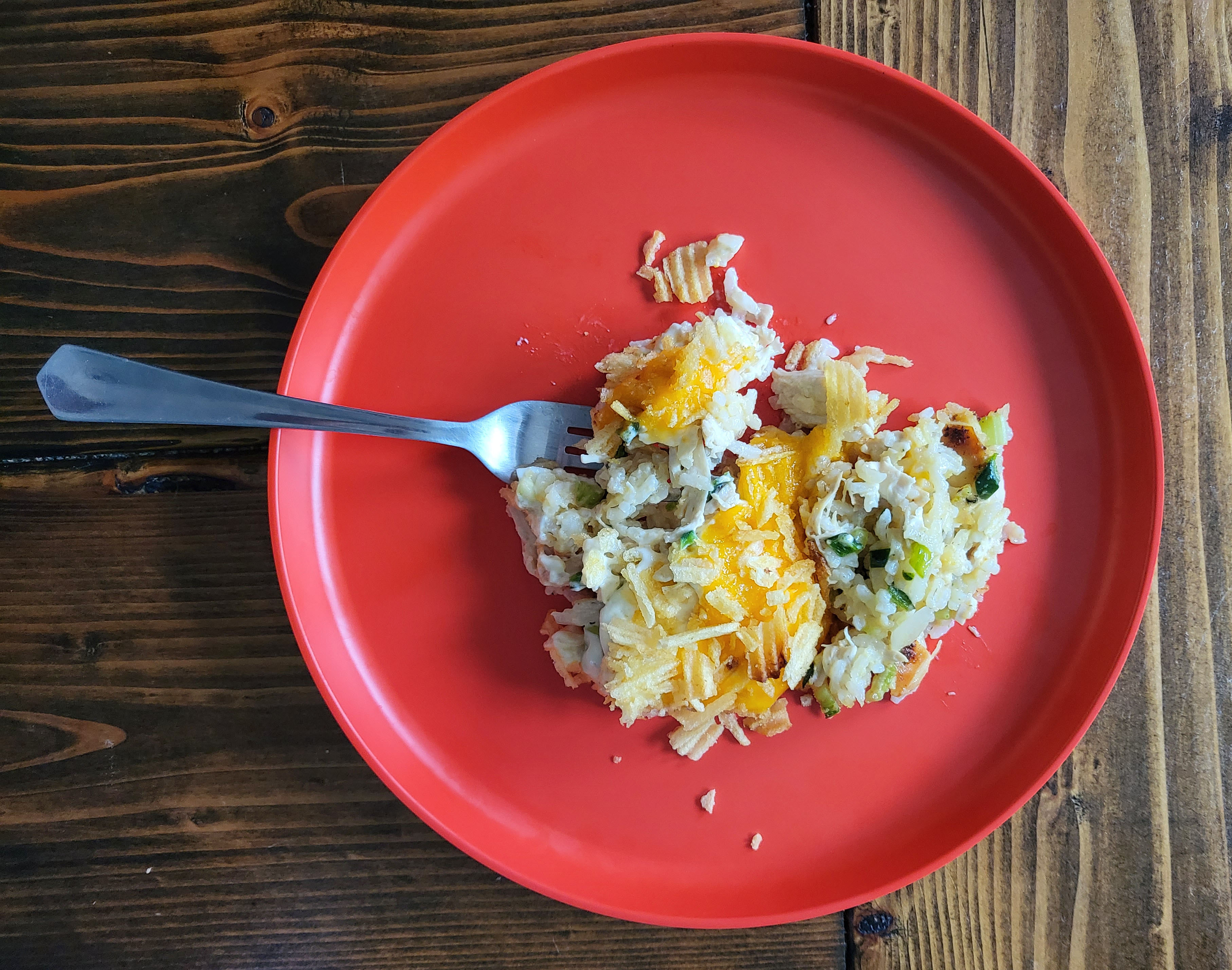
I was super hungry when I started this recipe, so I bought two rotisserie chickens. Aunt Ruth says this mixture should sit overnight in the fridge, so I knew we wouldn’t be eating it for another 24 hours. The plan was Gaby and I would eat one of the chickens with some rice and a salad for dinner that night. We decided against it, and Gaby said, “I’m just going to make a chicken salad.” While she did that, we both ate the hot chicken legs and thighs from the plastic bags and pulled and cut up chicken on our own cutting boards. It wasn’t until I’d finished putting this dish together and watching Gaby making her chicken salad that I realized what’s probably obvious to all of you…Aunt Ruth’s recipe is just baked chicken salad. It is exactly what it claims to be: a chicken salad, the kind you’d find in a deli on a sandwich, but heated up. With cheese and chips and rice and almonds.
I can imagine this recipe was born of a need to use-up leftovers from some family get-together. You just happen to have some chips and rice from another dish, and you’re just like…fuck it. Throw it all in there. Add some cheese. It was in that spirit that I once again spied all of the poblanos still on our prep table and threw one in, too.
For seasoning, there is only salt and pepper. I resisted the urge to add garlic and other flavors. I omitted the almonds because I just don’t really care about nuts. I let it sit all night in the fridge, but I really don’t see the point.
When we sat down to eat the next night, it looked pretty bland. My instinct told me to grab some hot sauce. Camila said she had a version of this with a family she worked for, and it had hot pepper cheese. I think that would’ve been good. Gaby said she thought the almonds really would’ve added something and Camila agreed. (dang) Gaby also didn’t care for the chips saying they taste stale after being baked. I liked them because they added some much needed flavor. I said, “Well, it really tastes like chicken salad that has been heated up.” We all agreed the crunch of the celery was nice. Not much more was said after that, and we slowly and hesitantly spooned more onto our plates until there wasn’t much left.
When I asked Gaby for her rating, she responded, “I ate it because I was hungry.”
Chef Gaby rating on a scale of 0 – Grandpa’s Pasta Sauce: 3.5
Up next week: Taco Salad and/or Marinated Make-Ahead Bean Salad.
Crunchy Chicken Salad Casserole
3 cups of cooked chicken (grab a rotisserie to make it fast)
1 cup chopped celery
1 cup chopped onion
1/2 cup sliced almonds (if you’re into that sorta thing)
1 can cream of chicken soup!
1 tablespoon lemon juice
1 1/2 cups cooked rice
1/2 teaspoon salt
1/2 teaspoon pepper
2 hard boiled eggs, chopped
3/4 cup mayonnaise
1/4 cup water
2 cups crushed potato chips (I used ruffles)
3/4 cup shredded cheddar cheese (or any cheese you desire!)
Toss first nine ingredients together in a large bowl. Mix the mayo and water in a separate bowl. Pour over first nine ingredients and mix well. Add the eggs and fold gently. Dump into a greased 9x 13 casserole dish.
Bake at 450 for 13 minutes. Add the chips and cheese and bake another 5 minutes or until you think it looks like a hot chicken salad casserole.
Sources: Why Did the Chicken Cross the World? The Epic Saga of the Bird that Powers Civilization, 2014. Andrew Lawler
Tastes Like Chicken: A History of America’s Favorite Bird, 2016. Emelyn Rude
 Knife and Pen